
By Jennifer Whitmire, MS, MEd, CHES, NEP
Earlier this week, we talked about why a carrot is orange.
That took us into beta-carotene, vitamin A, absorption, genetics, cooking, and even fall leaves. Today, I want to put that information into action.
Let’s make soup.
I chose carrots for obvious reasons. We just spent the week talking about beta-carotene, and I wanted a recipe that would give you a chance to put some of that science into practice.
I added red lentils, because I didn’t want this to be a bowl of pureed carrots and broth. The lentils give the soup more fiber and protein, make it creamy without dairy or coconut milk, and turn it into something that feels more like a complete meal.
I also added cauliflower, because, well, why not get another vegetable in there?
Yes, We’re Processing the Carrots, Again
Apparently, I’m on a mission to change the way you think about the word processed. We’re going to chop the carrots, cook them, and blend them.
All three are forms of processing.
Earlier this week, we talked about how carotenoids are held within the food matrix. Chopping and cooking can soften and disrupt some of that plant structure which can make beta-carotene more accessible during digestion.
That doesn’t mean cooked carrots are “better” than raw carrots. I eat both, but raw and cooked are not same once they reach your digestive system.
That’s one of the reasons I want you to eat whole foods prepared in lots of different ways instead of worrying about whether everything should be raw or cooked.
Why the Pumpkin Seeds?
You’ll notice that I didn’t add oil to the soup, but I did add pumpkin seeds on top.
Beta-carotene is fat-soluble, so having some fat with your carrots can help with carotenoid absorption. Pumpkin seeds give us some whole-food fat along with protein, minerals, and a little crunch. (Walnuts or hemp seeds would work, too).
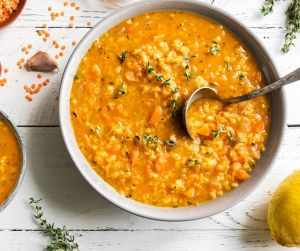
Creamy Carrot & Red Lentil Soup
Ingredients
- 1 pound carrots, chopped
- 1/2 cup dry red lentils, rinsed
- 1 small yellow onion, chopped
- 2 cloves garlic, minced
- 1 to 2 cups cauliflower florets
- 1 tablespoon freshly grated ginger
- 1 teaspoon ground cumin
- 1/2 teaspoon ground coriander
- 1/2 teaspoon turmeric
- 1/4 teaspoon smoked paprika
- 4 cups low-sodium vegetable broth
- 1 tablespoon fresh lemon juice
- Sea salt and black pepper, to taste
- 2 tablespoons pumpkin seeds
- Fresh parsley or cilantro
Instructions
Add the onion to a soup pot with a few tablespoons of vegetable broth and cook over medium heat until it begins to soften, about 3 to 4 minutes.
Add the garlic, ginger, cumin, coriander, turmeric, and smoked paprika. Stir for about 30 seconds. Add another splash of broth, if you need it.
Add the carrots, red lentils, cauliflower, and vegetable broth.
Bring everything to a boil, reduce the heat to simmer, cover, and cook for about 20 to 25 minutes. You want the carrots completely tender and the lentils very soft.
Blend until creamy with an immersion blender. If you’re using a regular blender, work in batches and be careful with the hot soup.
Add the lemon juice, then taste it.
Does it need more lemon? More cumin? A little pepper? Maybe some cayenne?
Don’t skip tasting your food.
Add a little water or broth if you want a thinner soup.
Spoon it into bowls and finish with pumpkin seeds and fresh parsley or cilantro.
Use What You Have
Don’t buy half the produce department because a recipe told you to. If you have a sweet potato that needs to be used, throw it in.
- Do you have some kale? Chop it and stir it into the finished soup.
- Do you have broccoli instead of cauliflower? Use it.
- You don’t have pumpkin seeds? Try hemp seeds or chopped walnuts.
- If your carrots aren’t quite a pound, I’m pretty sure the soup police aren’t coming.
Recipes are helpful, but learning how to look around your kitchen and work with what you already have is the best way to prevent wasting food.
One More Thing About Those Carrots
After this week’s article, it would be easy to walk away thinking, “Okay, beta-carotene. Eat carrots.”
I want you to think bigger than that.
Carrots are one source of beta-carotene. Sweet potatoes, pumpkin, winter squash, dark leafy greens, and other vegetables also contain carotenoids.
This soup just gives us one delicious way to put that idea into a bowl.
Most of the time, you don’t need to stand in your kitchen thinking about beta-carotene conversion or bioavailability. You need to understand enough of the science to make better choices, then get in the kitchen and decide. “How can I make this taste really good?”
If it doesn’t taste good, you’ll probably never eat it again.


Leave a Reply