
By Jennifer Whitmire, MS, MEd, CHES, NEP
Earlier this week, we talked about why blueberries are blue and what happens to their anthocyanins after we eat them. We also talked about antioxidants, the gut microbiome, and why the anthocyanin that goes into your mouth isn’t necessarily the same compound your cells eventually encounter.
That’s interesting science, but it doesn’t help if the food doesn’t taste good!
This week, we’re going to make blueberry chia pudding.
I’ve made chia pudding countless times, but I wanted this one to connect directly to what we’ve been learning about blue and purple foods. We’re starting with blueberries, then we’re adding another purple ingredient you may not expect in a chia pudding.
Purple cabbage?!
I know. It’s cabbage. Stay with me. (LOL!)
Why Am I Putting Cabbage in Chia Pudding?
Purple cabbage is one of my favorite examples when I’m teaching about anthocyanins, because you can actually watch its chemistry change.
Add lemon juice or vinegar to purple cabbage, and you can see it turn brighter pink or reddish-purple. You can see what happens when anthocyanins encounter an acidic environment.
I don’t want my breakfast tasting like coleslaw!
We’re only using a small amount, and we’re blending it with blueberries, lemon, vanilla, and a little sweetness, if you want. The blueberries remain the dominant flavor, and the cabbage gives us another whole plant and another source of anthocyanins. (It’s also a cruciferous vegetables, and I love getting at least one of those in a day!) This is also an easy way to practice plant diversity.
“How many different plants can I add to one dish?”
Chia Seeds Add Something Completely Different
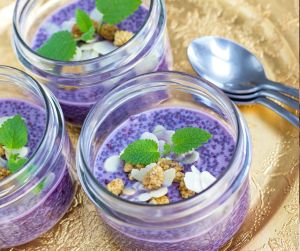
Chia seeds aren’t here for their color; though, they are available in different colors. They’re rich in fiber and alpha-linolenic acid, or ALA, a plant-based omega-3 fatty acid.
When chia seeds are mixed with liquid, their soluble fiber helps form the gel that turns this into pudding. That fiber also makes this recipe particularly appropriate after our conversation about the microbiome.
Anthocyanins aren’t the only thing reaching our gut microbes. The types of carbohydrates and fibers we eat help influence what’s happening in that microbial community, too.
Once again, we’re not eating isolated compounds. We’re eating real food.
Fresh or Frozen Blueberries?
I eat both.
I always have frozen berries, because they’re convenient, available year-round, and I don’t have to worry about eating an entire container before they grow fuzz.
Frozen blueberries also work here, because everything is going into the blender anyway.
If you have fresh blueberries, use them. If frozen is what you have, use those.
You don’t have to have a picture-perfect refrigerator to eat optimally.
Blueberry Chia Pudding With a Purple Twist
Ingredients
- 1 cup unsweetened almond milk
- 1 cup blueberries, fresh or frozen
- 1/4 cup finely chopped purple cabbage
- 1 tablespoon hemp seeds
- 1 tablespoon fresh lemon juice
- 1 teaspoon vanilla extract
- 1 Medjool date, pitted, or a few frozen cherries
- 1/2 teaspoon cinnamon
- Pinch of sea salt, optional
- 3 tablespoons chia seeds
- Additional blueberries, hemp seeds, walnuts, or pumpkin seeds for serving
Instructions
Add the almond milk, blueberries, purple cabbage, hemp seeds, lemon juice, vanilla, optional date or cherries, cinnamon, and optional salt to a blender.
Blend until completely smooth.
Taste it.
This is important, especially because blueberries vary so much in sweetness. If it needs more sweetness, add another small piece of date or a few cherries. If you want the blueberry flavor brighter, add a little more lemon.
Pour the mixture into a bowl or jar, and stir in the chia seeds.
Let it sit for about 5 minutes, and stir it again, so the chia doesn’t clump. Then, cover and refrigerate for at least 2 hours or overnight.
When you’re ready to eat it, give it another stir. If it’s thicker than you like, add a splash of almond milk.
Top with more blueberries and a small amount of walnuts, pumpkin seeds, or hemp seeds.
Want More Protein?
Chia pudding can look substantial while still being a fairly light breakfast. If you’re eating this as your entire breakfast, think about what else is in your bowl.
You could increase the hemp seeds, add some of your favorite dairy-free yogurt, add a 1/4-1/2 cup cooked whit beans or lupini beans, or serve the pudding with another whole-food source of protein.
If you’re using it as a snack or dessert, the original recipe may be plenty.
This is another reason I don’t love labeling foods as “high protein,” “low carb,” or even “healthy” without looking at the rest of the meal and the person eating it.
Don’t Want Cabbage in Your Breakfast?
Leave it out. Seriously.
I want you to try new foods, but I don’t want you choking down something you hate, because I told you anthocyanins are good for you.
You could make the pudding with blueberries alone or add blackberries for another source of anthocyanins.
You could also serve it with walnuts or a few purple grapes or cherries when they’re in season.
The point is variety.
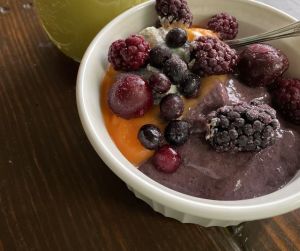
Look at That Color
Before you eat, take a second and look at it. That deep purple color is speaking to you.
Earlier this week, we learned that anthocyanins are responsible for many of the blue, purple, and red colors we see in plants. We also learned that after we eat them, digestion, metabolism, and our gut microbes can transform those compounds.
You don’t need to think about anthocyanin metabolites while you’re eating breakfast. LOL!
I just want you to start getting curious when you look at your food.
What colors do I see?
What all is in there?
What happens when I chop it, blend it, cook it, or eat it?
And, … How can I make this taste really good?
If it doesn’t taste good, you’ll probably never eat it again.


Leave a Reply