

By Jennifer Whitmire, MS, MEd, CHES
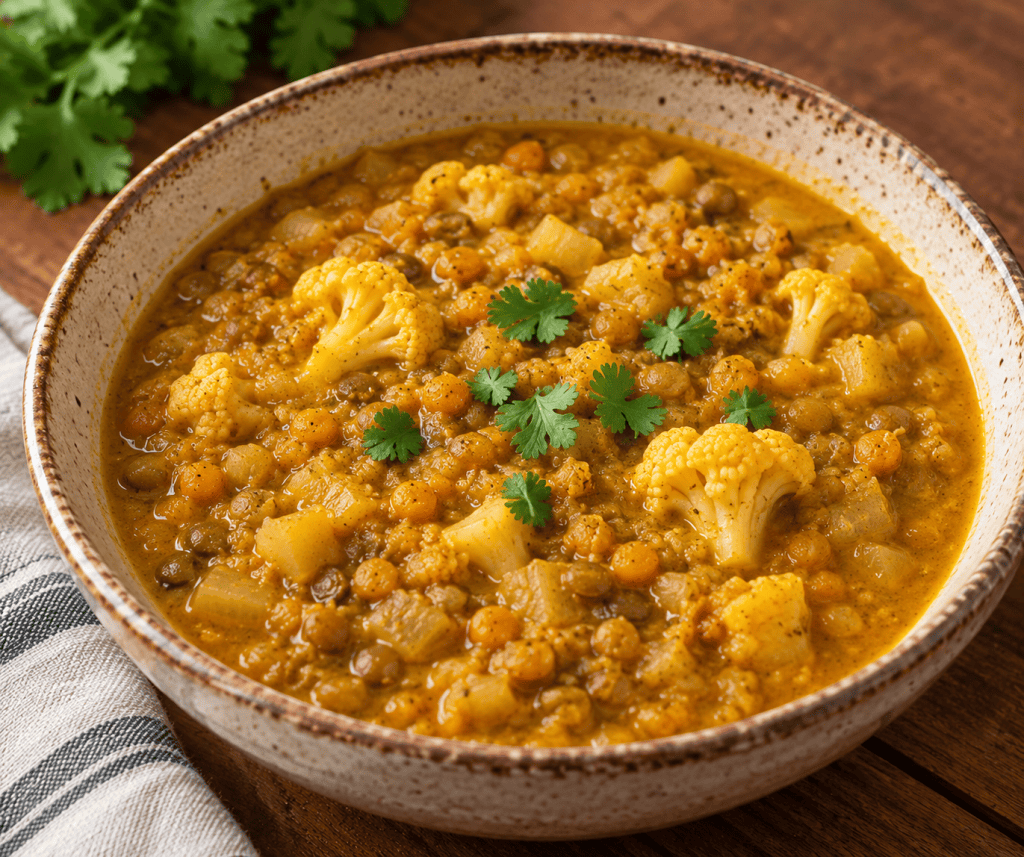
After spending the week talking about turmeric, it only makes sense to actually cook with it. This Golden Cauliflower & Red Lentil Curry combines almost all of the colors of the rainbow from turmeric with ginger, garlic, cumin, coriander, cauliflower, yellow bell pepper, and red lentils. The lentils cook down into the sauce, and a little cashew butter adds creaminess without needing coconut milk or oil.
This is the type of recipe I love, because you don’t have to follow the rules! I mean ingredient list, of course. If you have broccoli instead of cauliflower or a red pepper instead of yellow, use it. We’ll get to some other easy swaps, but first let’s talk about why these ingredients work so well together.
Using Turmeric in an Actual Meal
Earlier this week, we talked about curcumin, one of the compounds responsible for turmeric’s beautiful yellow color. We also looked at the familiar recommendation to combine turmeric with black pepper, because piperine, a compound in black pepper, can increase curcumin’s bioavailability.
That’s interesting science, but I don’t want it to turn into another food rule. You don’t have to add a specific amount of black pepper every time you use turmeric or worry that you’ve somehow wasted the turmeric if you forget it.
In this curry, I’m using black pepper, because it tastes good with turmeric, ginger, cumin, and coriander. It also happens to give us a real-life example of something we just learned.
The same goes for the cashew butter. Curcumin has an affinity for fats, and this recipe includes a small amount of whole-food fat from cashews. I’m not adding it because dinner needs to become a curcumin-absorption experiment but because it gives the curry a little richness and makes it taste really good.
Why I Added Red Lentils
I could have made this a cauliflower curry, but I wanted it to work as dinner, not just a vegetable side dish, which you can absolutely do! Red lentils add fiber, protein, folate, iron, potassium, and other nutrients, while also helping create the texture of the sauce.
If you’ve cooked with red lentils before, you know they are different from brown or green lentils. They soften and begin to break apart as they cook, which is what I want here. By the time the cauliflower is tender, the lentils have thickened the broth and given us a creamy curry without needing to puree anything.
Don’t Ignore the Cauliflower Just Because It’s White
It may seem strange that one of the main ingredients in a recipe for our yellow week is cauliflower, but I actually think it’s a perfect fit for what we’ve been learning.
We’ve been using color as a way to explore some of the compounds inside our food, but color was never supposed to become another classification system. Cauliflower doesn’t have the bright color of turmeric or yellow peppers, yet it’s a cruciferous vegetable and contains glucosinolates.
When we chop cauliflower, we’re disrupting its plant cells and starting some of the same chemistry we explored when we talked about broccoli.
Now look at what’s happening in this one recipe. Turmeric contains curcuminoids. Cauliflower adds glucosinolates. Yellow pepper contains carotenoids and vitamin C. Lentils add fiber, resistant starch, protein, minerals, and polyphenols. Onion, garlic, and ginger add still more plant compounds.
That’s much closer to the way I want us to think about food. We can learn about curcumin without turning the entire meal into a delivery system for curcumin.
Golden Cauliflower & Red Lentil Curry
Ingredients
- 1 small yellow onion, chopped
- 3 cloves garlic, minced
- 1 tablespoon freshly grated ginger
- 1 tablespoon ground turmeric
- 1 teaspoon ground cumin
- 1 teaspoon ground coriander
- 1/4 teaspoon black pepper
- Pinch of cayenne or red pepper flakes, optional
- 1 yellow bell pepper, chopped
- 4 cups cauliflower florets
- 3/4 cup dry red lentils, rinsed well
- 3 cups low-sodium vegetable broth
- 1 tablespoon cashew butter
- 1 to 2 tablespoons fresh lemon juice
- Sea salt, to taste
- Fresh cilantro or parsley, for serving
Instructions
Add the onion to a large pot or deep skillet with a few tablespoons of vegetable broth. Cook over medium heat for about 4 to 5 minutes, stirring occasionally, until the onion begins to soften. Add the garlic, ginger, turmeric, cumin, coriander, black pepper, and cayenne if you’re using it. Stir for about 30 seconds, adding another splash of broth if the spices begin to stick.
Add the yellow bell pepper, cauliflower, red lentils, and vegetable broth. Bring everything to a boil, then reduce the heat, cover, and simmer for about 20 to 25 minutes.
Give it a stir occasionally as it cooks. The cauliflower should be tender and the lentils should be very soft and beginning to break down into the broth.
Stir in the cashew butter and start with 1 tablespoon of lemon juice. Now taste it. Depending on your broth and your own preferences, you may want more lemon, cumin, black pepper, salt, or a little more heat.
If the lentils have made the curry thicker than you like, add a little more broth or water until it’s the consistency you want.
Finish with fresh cilantro or parsley and serve.
What Should You Serve With It?
This can easily be dinner on its own. You already have lentils and a generous amount of vegetables in the bowl, so you don’t necessarily need to build an elaborate meal around it.
I would probably add something fresh or crunchy on the side, because I like the contrast with a creamy curry. A simple salad, cucumber, shredded cabbage, or steamed greens would all work. You could also serve it over cauliflower rice or, if grains work for you, add a small serving of your favorite whole grain. You could also throw in a bunch or kale or spinach.
Use What’s Already in Your Kitchen
Please don’t make a special trip to the grocery store, because you have a red bell pepper instead of a yellow one. Use the red pepper. The curry will survive, and you’ll get a slightly different combination of plant compounds in the process.
Broccoli can replace some or all of the cauliflower. Zucchini would be easy to add, and spinach or kale can go into the pot during the last few minutes of cooking. If you have a sweet potato that needs to be used, dice it fairly small and add it with the lentils. You may need a little more broth and cooking time.
The same flexibility applies to the cashew butter. Almond butter would work, or you can leave it out. The recipe is a starting place, not a reason to buy six new ingredients when you already have perfectly good food in your kitchen.
Yellow Doesn’t Mean One Thing
We started this week with a simple question about turmeric and ended up talking about curcumin, bioavailability, black pepper, supplements, and the difference between eating a whole spice and taking a concentrated compound.
Now we’re looking at a bowl of curry that makes the lesson even clearer. Turmeric and yellow bell pepper are both yellow, but they don’t share the same chemistry. The white cauliflower adds compounds we don’t get from either of them, and the lentils, onion, garlic, ginger, lemon, and herbs add even more.
This is why I don’t want the rainbow to become another nutrition checklist where red means one compound, orange means another, and yellow means curcumin. Color gives us a clue, but it is only part of the whole picture of nutrients. The real value comes from eating a variety of whole foods and becoming curious about what each one adds to the meal.
Understanding some of that science can help us make more thoughtful choices in the kitchen, but eventually we still have to make dinner. That’s when I come back to the question I ask all the time, How can I make this taste really good?
If it doesn’t taste good, you’ll probably never eat it again.


Leave a Reply