

By Jennifer Whitmire, MS, MEd, MH, CHES, NEP
Most people come to me believing they need a better plan, more structure, or a new set of recipes to follow. They feel like they already have a general understanding of what they should be eating, but something is not working, and it’s not translating into consistent results.
Most of my clients have already tried every diet out there. They have gathered information, watched every summit, made changes, and put in lots of effort, but their energy is unpredictable, their digestion is also unpredictable, and/or their symptoms have not changed in the way they expected. They are wondering if eating plant based is necessary or optional.
I can tell you right away that the issue is not a lack of information. It is the gap between knowing what is needed and actually taking action.
I remembering saying ALL of these when I first tried to go whole food plant based.
*Where do I start?
*What does a balanced WFPB meal even look like?
*How can I do this consistently in a way that actually supports my body and its functions?
*How do I make sure I’m getting all of the nutrients my body needs? What about Protein?
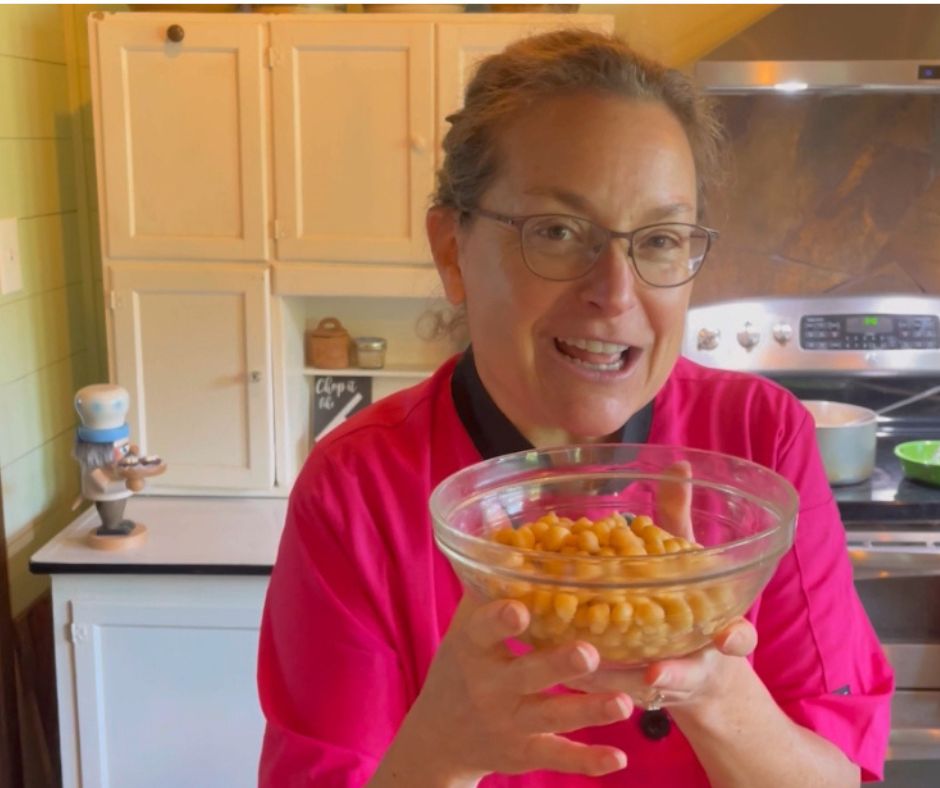
This is what changes when we are in a kitchen together.
Where We Start
We do not begin with a strict plan or a list of rules. We begin by looking at what is already happening on a daily basis. I want to know where you are right now.
- What does a typical day of eating look like?
- Give me a 3 day food journal or a list of when and what you eat regularly
- Where does energy fluctuate? When is it high and when is it low?
- When do you typically have enough energy to get things done?
- If you workout, what time of day is best for you?
- If you work or do daily projects, what time of day are you at your best?
- When do cravings or fatigue show up?
- Do you need a mid-morning nap? Sleep ‘til noon? Or take a 3 pm nap?
- Do you have to have a 10am banana or a 3pm “treat?”
These patterns tell me more than any general recommendation ever could.
From there, we begin to adjust. We don’t change everything at once, but we identify where the current pattern is not supporting stable energy, digestion, or blood sugar.

What We Learn Very Quickly
One of the first things people begin to recognize is how much their meals are influencing how they feel throughout the day. Are nutrient patterns being consistently met?
When meals are not balanced in a way that supports blood sugar, there is usually a predictable pattern of energy spikes followed by drops. Many people have been experiencing this for so long that it feels normal, until they begin to feel something different. What started as a sugar “need,” aka that banana or treat, is now a habit.
I totally get it! I got into the habit of having a few chocolate chips after lunch every day. Even when I was stuffed, I’d still go to the fridge to grab my chocolate fix. If I’m stuffed, this habit is not helping me with my health.
As we start creating balanced meals together, the focus moves toward stability.
We look at how each meal is structured and whether it is providing what your body and/or your family needs to maintain steady energy. Small adjustments in meals often lead to noticeable differences in how someone feels within a short period of time.
What We Actually Do in the Kitchen
Cooking in this setting is not just following a recipe step by step. We learn how to create meals in a way that works consistently, regardless of what ingredients are available. This is what it looks like in everyday meals, even in simple, repeatable recipes.
We work with whole, plant foods as the foundation. Beans, greens, vegetables, fruits, nuts, and seeds provide the base structure, and from there we create meals that support satiety, digestion, and energy.
Instead of focusing on getting it just right and making the perfect meal, we focus on repeatability. The goal is not to create one ideal meal but to create a pattern that can be used again and again without requiring constant effort or decision-making or finding that specific recipe.
This approach removes the pressure and allows cooking to become more intuitive over time.

What People Do Not Expect
Many people assume that eating this way will require complicated recipes, hours in the kitchen, or a complete change in how they approach food.
What they find instead is that once the structure of a meal is understood, the process becomes much simpler.
Meals do not need to be elaborate to be effective. The most supportive meals are also the most straightforward, as long as they are created with the right balance of nutrients.
Another common surprise is how quickly the body begins to respond. Changes in energy, digestion, and even focus begin as quickly as 2-3 days in most cases. I’ve now lost count of how many clients have actually gone off pain meds and cancelled surgery, because they reduced inflammation from diet alone. Can I promise you that? NO. But, I think it’s worth it to give it a try.
The Difference Between Knowing and Doing
Most people already understand which foods are generally considered healthy. (We all know that Cheetos are NOT a healthy food.) The challenge is not identifying those foods but learning how to combine foods in a way that produces consistent results.
In the kitchen, that becomes clear. We take what you already know and organize it into a structure that can be applied in real life. I remembering struggling to figure out what a meal would even look like with meal. You can’t just take out the meat. How can I change my meals, so I don’t end up needing more food in a couple of hours?
This is where consistency begins to develop. When meals are no longer based on guesswork, it becomes much easier to maintain a pattern that supports the body.
How the Body Responds Over Time
As cooking this way become more consistent, the body begins to respond in measurable ways.
Energy is more stable, there’s less cravings for snacks or stimulants like caffeine. Digestion becomes more predictable as the gut receives consistent fiber and nutrients. The microbiome is much happier. Hunger cues become clearer and more reliable.
These changes are not tied to a single food or ingredient. They are the result of a shift in the overall pattern of eating.

Why This Approach Works
There are several physiological reasons this approach is effective.
- Increasing fiber supports blood sugar and feeds beneficial gut bacteria which influences digestion, immune function, and inflammation.
- Increasing the intake of nutrient-dense, plant foods provides the vitamins, minerals, and phytonutrients needed for energy production and cellular repair.
- Reducing foods that contribute to inflammation allows the body to function more efficiently.
- Long-term research on plant-based diets shows reversal in chronic disease
These factors work together, which is why the results are more noticeable when we eat this way consistently instead of occasionally.
What People Leave With
At the end of a session, people are not leaving with a rigid plan or a set of rules to follow. They leave with a framework that allows them to evaluate and create meals on their own.
They understand how to look at a meal and determine whether it will support stable energy and digestion. They know how to make adjustments without starting over, and they feel more confident in their ability to make decisions in their own kitchen.
This creates a level of independence that is difficult to achieve through written plans without personal support.
What This Changes Long-Term
Over time, this approach reduces the need to constantly manage symptoms or fixing something right away aka short-term strategies.
When the body is consistently supported through food, it becomes more stable. Energy and digestion become more predictable which allows us to focus less on managing health and more on living our daily lives.
Why Learning This in a Kitchen Matters
There is a difference between understanding a concept and experiencing it. In the kitchen, adjustments can be made in real time. Questions can be answered immediately, and the impact of small changes can be observed directly.
This makes the process more practical and more effective, because it is being applied in real time rather than through theory.
A Different Kind of Confidence
Confidence in the kitchen is so important when it comes to cooking for our health. We can all read a recipe. Confidence comes from understanding how to support the body through consistent patterns.
Once that understanding is in place, it becomes much easier to maintain, even when we get thrown a curve ball. Sometimes, we forget to pick up something, soak something, or prep something ahead of time. Life happens! When you learn confidence in the kitchen, you can totally wing it and end up with a delicious health-ish if not completely health meal.
What This Is Really About
I’m not just talking about cooking or preparing meals. We’re creating a routine, a consistent environment, a new habit that allows the body to function more efficiently.
Food is one of the most direct ways to influence that environment. When it is used intentionally and consistently, the effects extend far beyond the kitchen.


Leave a Reply