
By Jennifer Whitmire, MS, MEd, CHES
We’ve made our way through green broccoli, red tomatoes, orange carrots, and blue and purple berries. I missed yellow.
I could have started with a lemon or a yellow bell pepper, but turmeric gives us a much more interesting story. Is it orange or yellow?
If you’ve ever cooked with turmeric, you already know how quickly everything turns yellow. A pinch of turmeric can turn an entire pot of soup golden. It can also turn your cutting board, countertop, dish towel, and probably your favorite shirt yellow if you’re not careful.
I also learned while writing this that different varieties are different shades of yellow to yellow orange depending on their curcuminoid content, where they’re grown, and growing conditions such as soil, temperature, and rainfall.
Why Is Turmeric Yellow?
Turmeric comes from the rhizome of Curcuma longa, a plant in the same family as ginger.
Its yellow to yellow-orange color comes from a group of compounds called curcuminoids. Curcumin is the best known of them. There are also demethoxycurcumin and bisdemethoxycurcumin.
Curcumin is also a polyphenol.
There’s that word again. We talked about polyphenols last week when we looked at the anthocyanins in blueberries. Anthocyanins and curcumin are both considered polyphenolic compounds even though they look different and behave differently.
This is a good place to clear up something that could easily get confusing as we work our way through the rainbow.
Yellow isn’t a phytonutrient.
Turmeric is yellow, because of curcuminoids. A yellow bell pepper contains carotenoids. Lemons contain flavonoids, including flavanones. Other yellow foods have completely different combinations of compounds.
Foods can share a color without sharing the same chemistry, which is why I encourage you to consume different foods in each color family, as well. Tomatoes and bell peppers, carrots and sweet potatoes, yellow squash and turmeric, kale and asparagus, and blueberries and purple cabbage.
Why Do We Hear So Much About Curcumin?
If you’ve spent any time in the supplement aisle (or on social media), you’ve probably seen curcumin.
It has been studied extensively for its interactions with pathways involved in inflammatory signaling and oxidative stress. Researchers have also investigated curcumin in a wide range of health conditions. That doesn’t mean turmeric cures inflammation.
Even though so many people praise it, Inflammation isn’t a switch that we turn on and off, and curcumin isn’t an anti-inflammatory drug hiding inside your spice cabinet.
Inflammatory signaling is part of normal physiology. We need it for immune responses, tissue repair, and healing. Problems develop when inflammatory processes become excessive, inappropriate, or chronic (The switch doesn’t turn off).
Curcumin appears to interact with multiple molecular targets involved in these processes, which is one reason it continues to receive so much research attention.
The science is interesting, but what happens after we eat it?
Curcumin Has a Bioavailability Problem
Curcumin looks impressive in laboratory research. Getting meaningful amounts of unchanged curcumin into circulation after we swallow it is another story.
Curcumin has relatively poor oral bioavailability. It isn’t absorbed well, and what is absorbed is rapidly metabolized and eliminated.
Does this sound familiar?
Knowing that a compound is present in a food doesn’t tell us exactly how much our bodies will absorb, what form it will take after metabolism, or what it will ultimately do.
With tomatoes, we talked about lycopene and bioavailability.
With carrots, we added conversion because beta-carotene can be converted into vitamin A with the BCMO1 enzyme (Some of us struggle due to a SNP variant in BCMO1).
With blueberries, we looked at what happens when our own metabolism and our gut microbes transform anthocyanins.
Now turmeric gives us another example.
Curcumin is there in the turmeric, but that doesn’t mean all of it ends up circulating through your body as curcumin.
What About Turmeric and Black Pepper?
You’ve probably heard this advice, “Always add black pepper to turmeric.”
There’s a reason behind it.
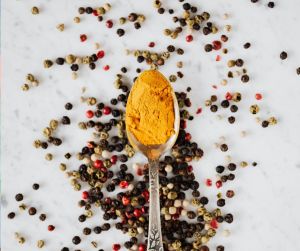
Black pepper contains a compound called piperine. Piperine can increase curcumin’s bioavailability by interfering with some of the processes involved in its metabolism and elimination. It’s usually simplified like this:
Turmeric + black pepper = better absorption.
If something slows the metabolism of one compound, we should at least consider whether it can affect the metabolism of other compounds, too.
Piperine can interact with drug-metabolizing enzymes and transporters. That’s one reason concentrated curcumin-piperine supplements deserve caution over sprinkling turmeric and black pepper into dinner, especially for someone taking medications.
I don’t want you afraid of putting pepper in your curry, but I do want us to stop assuming that more bioavailable automatically means better.
Sometimes changing bioavailability changes more than we intended.
Turmeric, the Food, Isn’t the Same as Curcumin the Supplement
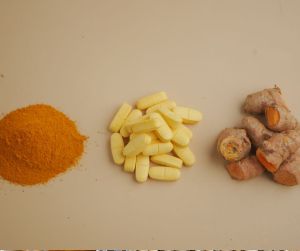
This distinction is important. When you add turmeric to soup, curry, lentils, vegetables, or a dressing, you’re eating a culinary amount of the whole spice. Turmeric contains curcumin, but turmeric and curcumin aren’t interchangeable.
A concentrated curcumin supplement can provide amounts and formulations very different from what you’d get by seasoning dinner. Some supplements are specifically designed to dramatically increase absorption.
That doesn’t mean certain supplements are good or bad. It means they’re different from the food.
This is why I prefer a food-first approach whenever possible. I want to understand the interesting compounds in our food. I just don’t want to forget the food while we’re studying them.
Does Turmeric Need Fat?
Curcumin is poorly soluble in water and is lipophilic, meaning it has an affinity for fats. Researchers have explored lipid-based formulations as one strategy for improving curcumin delivery and bioavailability.
In the kitchen, turmeric also happens to work well in meals that contain some whole-food fat.
*Lentils with turmeric and a little tahini.
*Vegetables with turmeric and chopped nuts or seeds sprinkled on top.
*Curry with turmeric and cashews.
*Soup with turmeric and topped with pumpkin or hemp seeds.
I don’t want you to worry about measuring a set amount fat grams to make your turmeric “work.” That’s the kind of nutrition anxiety I’m trying to get us away from.
Just prepare a balanced meal with a good source of protein, carbs, and fat.
Yellow Doesn’t Mean Curcumin
We’ve been using color as a doorway into phytonutrients, but I don’t want you to think:
- Red means lycopene
- Orange means beta-carotene
- Blue means anthocyanins
- Yellow means curcumin
A lemon and turmeric both look yellow, but they don’t contain the same collection of plant compounds, and neither do pineapple, yellow peppers, yellow squash, golden beets, or ginger.
Turmeric even contains much, more than curcumin.
Use the Turmeric
None of this requires you to calculate curcumin bioavailability while making dinner. Use turmeric because you like it.
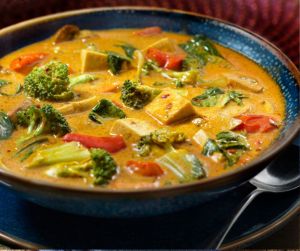
- Add it to lentils, beans, cauliflower, soups, curries, tofu, dressings, or roasted vegetables.
- Try fresh turmeric if you find it.
- Add black pepper, because it tastes good with the dish not because you think dinner has failed without it.
Eat other yellow foods, too.
Enjoy lemon in your water, yellow bell pepper on your salad, roast some golden beets, and add a little pineapple to your chia bowl.
Color gives us an easy way to notice variety, but the goal is to become curious about what’s actually in our food.
We’ve learned something different from every color so far. What’s in the food and what ultimately reaches our tissues aren’t necessarily the same thing.
That’s why I like to appreciate just how much happens between the garden, the kitchen, and our cells.
But… as always, we have to decide how can I make this taste really good?
If it doesn’t taste good, you’ll probably never eat it again.
References
Hewlings SJ, Kalman DS. Curcumin: A review of its effects on human health. Foods. 2017;6(10):92. doi:10.3390/foods6100092. PMCID: PMC5664031. PubMed Central (PMC)
Lopresti AL. The problem of curcumin and its bioavailability: Could its gastrointestinal influence contribute to its overall health-enhancing effects? Adv Nutr. 2018;9(1):41–50. doi:10.1093/advances/nmx011.
Stohs SJ, Chen O, Ray SD, Ji J, Bucci LR, Preuss HG. Highly bioavailable forms of curcumin and promising avenues for curcumin-based research and application: A review. Molecules. 2020;25(6):1397. doi:10.3390/molecules25061397.
Shoba G, Joy D, Joseph T, Majeed M, Rajendran R, Srinivas PS. Influence of piperine on the pharmacokinetics of curcumin in animals and human volunteers. Planta Med. 1998;64(4):353–356. doi:10.1055/s-2006-957450.
Moghaddam NS, et al. Curcumin-piperine co-supplementation and human health: A comprehensive review of preclinical and clinical studies. Phytother Res. 2023;37(4):1462–1487. doi:10.1002/ptr.7737. PMID: 36720711. PubMed


Leave a Reply