
By Jennifer Whitmire, MS, MEd, CHES
If you’ve been following me for a while, you’ve heard me say, “Eat the rainbow.” It’s my #2 rule after Read the Ingredients. I say it all the time, and I absolutely mean it.
Eating a wide variety of colorful, whole, plant foods is one of the easiest ways to get a greater variety of nutrients and phytonutrients into your meals. You were probably told to eat a diverse diet or to have more variety. Eating the rainbow is a simple way to do that.
Lately, I’ve been thinking about that rule in a new way. Telling you to eat the rainbow isn’t enough. I don’t want you adding blueberries to your breakfast for blue or broccoli to your dinner for green just because you’ve heard they’re good for you. I want you to understand why they’re good for you.
I want you to understand the rainbow.
Once understand what is actually in these foods, I think you’ll start looking at what’s on your plate in a brand new way.
There Is a Reason I Get Excited About Purple Cabbage
I know. It’s cabbage.
When I walk through the produce department or a farmer’s market, I don’t just see fruits and vegetables. I see all of these vibrant colors, which are clues to the compounds that plants make, and I think about what happens when we eat them.
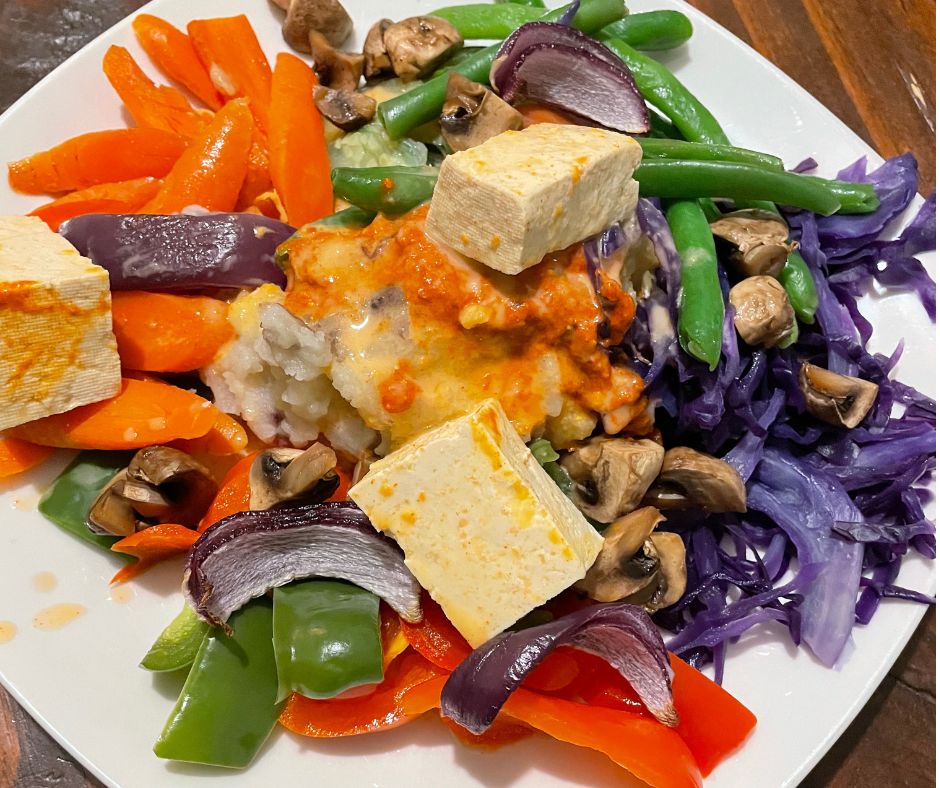
The deep purple in cabbage, blueberries, and blackberries gives us a clue that anthocyanins are present. These compounds are being studied in areas such as cardiovascular and brain health. The orange in carrots and sweet potatoes points us toward carotenoids, including beta-carotene, which our bodies can convert to vitamin A, a nutrient important for immune function, vision, and the maintenance of healthy tissues. The beautiful red in tomatoes comes in part from lycopene.
There are also foods that don’t fit neatly into our colorful rainbow. Garlic, onions, mushrooms, cauliflower, beans, nuts, and seeds are not particularly vibrant, but they contain their own impressive collection of nutrients and plant compounds.
This is the part of nutrition I want more people to understand. We’re told to eat more fruits and vegetables, but does anyone explain why?
What makes eating blueberries in a chia pudding different from blueberries in a blueberry breakfast bar? Why isn’t taking vitamin C, an isolated vitamin, the same thing as eating the whole food that contains it?
Why do I encourage you to use herbs and spices generously? Why is eating a variety of plants important?
Those are the questions I want us to start asking.
We’ve Reduced Food to Numbers
Our society is very good at breaking food into individual pieces.
Calories. Protein. Carbs. Fat. Maybe fiber if we’re paying attention.
Those things don’t tell us enough about the food or the nutrition found in the food.
A blueberry is more than a little package of carbohydrates, broccoli is a whole lot more than fiber with some vitamin C, and walnuts aren’t just a healthy fat.
Whole foods are incredibly complex. Plants contain vitamins, minerals, fiber, protein, fats, and thousands of naturally occurring compounds, many of which scientists are still studying and trying to understand. Those compounds also don’t arrive one at a time. We consume them together within the structure of the food and in combination with many different compounds.
This is one of the reasons I have spent so many years teaching people how to use real food. The deeper I go into nutrition and biochemistry, the more fascinated I become by what nature has already put on our plates.
What Does Color Have to Do With It? A Lot.
There’s a reason why these plants produce these compounds. They may help the plant interact with sunlight, protect it from UV radiation, respond to environmental stress, defend itself from pests or other invaders, or attract pollinators.
Many of the compounds plants produce contribute to the colors we see, although color is only one clue to what’s inside a food. One color doesn’t represent one phytonutrient, and some of the most interesting plant compounds are found in foods that aren’t that colorful at all.
This is why variety is important. When we eat many different plant foods, we give ourselves the chance to consume a much broader mix of nutrients and naturally occurring plant compounds.
Eating broccoli every day may be a wonderful habit, but broccoli cannot give us everything that blueberries, tomatoes, mushrooms, lentils, walnuts, parsley, and sweet potatoes provide. Even a simple switch from broccoli today to Brussels sprouts tomorrow changes the mix of nutrients and phytonutrients on your plate.
I want us to eat dark leafy greens and cruciferous vegetables, red tomatoes and peppers, orange carrots and sweet potatoes, purple cabbage and blueberries with garlic, onions, mushrooms, beans, herbs, spices, nuts, and seeds.
The goal is diversity.
Please Don’t Turn This Into Another List to Memorize
The last thing I want is for you to finish this article thinking you need to memorize which phytonutrient belongs to which color.
I want you to become curious about your food.
The next time you’re standing in the produce department or at the farmer’s market, look around and ask a few questions. Why is that food purple? What compounds are responsible for that color? What do we know about them? Does cooking change their availability? Does chopping or blending make a difference? Would combining that food with something else help us absorb certain nutrients?
Don’t forget the best question!
How can I make this taste really good?
If it doesn’t taste good, you’ll probably never eat it again. You don’t have to know the answers to the questions above! Just eat the colorful foods.
You know I love the science. Give me an interesting biochemical pathway, and I can happily disappear down that rabbit hole.
Science alone doesn’t change what we eat.
Knowing that broccoli contains glucosinolates is fascinating. It isn’t particularly useful if the broccoli you bought last week is slowly turning yellow in the back of the refrigerator, because you don’t know what to do with it and aren’t interested in actually eating it.
That is where the kitchen becomes just as important as the science.
Bringing the Science Into the Kitchen
This is what I want to explore with you.
Over the coming weeks, we’re going to look more closely at the foods we eat every day and what makes them so great. We’ll explore phytonutrients, fiber, and some of the biochemistry happening inside the body after we eat, without turning this into a biochemistry textbook.
We’ll also look at what happens in the kitchen. Chopping, blending, soaking, sprouting, fermenting, and cooking can change our food in different ways. In some cases, cooking improves the availability of certain compounds. Sometimes preparation methods matter for particular nutrients, and sometimes pairing foods together can influence how well we absorb certain nutrients and plant compounds.
We’ll figure out how to turn what we’re learning into food we actually want to eat, because that connection has always been the part I care about most. Let’s combine the science with the food, the kitchen, the plate, and real life.
My goal is for you, the reader, to understand enough to walk into your kitchen and use what you’ve learned.
I’m still going to tell you to eat the rainbow.
I’m also going to teach you how to understand it.
Want to put this into practice? Come back Friday, when we’ll take the science into the kitchen and turn the rainbow into something you can actually put on your plate.
Understanding food is important. Knowing what to do with it is where the fun begins.
References & Further Reading
Want to dig a little deeper into the science? Here are a few resources behind what we explored in this article:
National Institutes of Health, Office of Dietary Supplements. Vitamin A and Carotenoids: Fact Sheet for Health Professionals.
A helpful overview of carotenoids, beta-carotene, vitamin A conversion, vision, immune function, and food sources. NIH: Vitamin A and Carotenoids
Yadav S, Sharma A, Bishnoi S, et al. The Role of Anthocyanins in Cardiovascular Health: A Review. Current Cardiology Reviews. 2026.
A recent review of anthocyanins and the research surrounding their relationship with cardiovascular health. Read the review on PubMed
Barba FJ, Nikmaram N, Roohinejad S, et al. Bioavailability of Glucosinolates and Their Breakdown Products: Impact of Processing. Frontiers in Nutrition. 2016.
Explores glucosinolates in cruciferous vegetables and how storage, chopping, cooking, and other processing methods can influence their breakdown and bioavailability. Read the review
Carotenoids: Dietary Sources, Extraction, Encapsulation, Bioavailability, and Health Benefits—A Review of Recent Advancements. Antioxidants. 2022.
A broader review of carotenoids, including beta-carotene, lycopene, lutein, and zeaxanthin, their food sources, and factors affecting their bioavailability. Read the review


Leave a Reply