
My Massaged Kale Salad And Easy Green Swaps
By Jennifer Whitmire, MS, MEd, CHES
Earlier this week, we talked about what is actually happening inside our green vegetables. We got into chlorophyll, nitrates, glucosinolates, myrosinase, and even what happens to broccoli when you chop and cook it.
Today, I want to do something easier. I want you to eat some greens.
When I say “eat your greens,” I don’t mean find one green vegetable you like and eat it every day for the rest of your life. Spinach is wonderful, but spinach isn’t the same as kale, broccoli, or arugula. Even though they’re all green, they don’t contain exactly the same nutrients and phytonutrients.
That’s one of the ideas behind Understand the Rainbow that I really want you to remember. Variety doesn’t only mean eating different colors. There is plenty of variety within each color, too.
Today’s salad is an easy way to start.
Why Kale and Spinach?
The base of this salad uses both kale and spinach, but they aren’t interchangeable nutritionally.
Kale is part of the cruciferous vegetable family with broccoli, cabbage, Brussels sprouts, bok choy, cauliflower, and arugula. That means kale gives us some of those glucosinolates we talked about earlier this week.
Spinach belongs to a different plant family and has its own nutritional profile. It’s a source of folate and carotenoids such as lutein and zeaxanthin for the eyes and with vitamin K, magnesium, and other nutrients.
Putting them together gives us more variety than using either one alone.
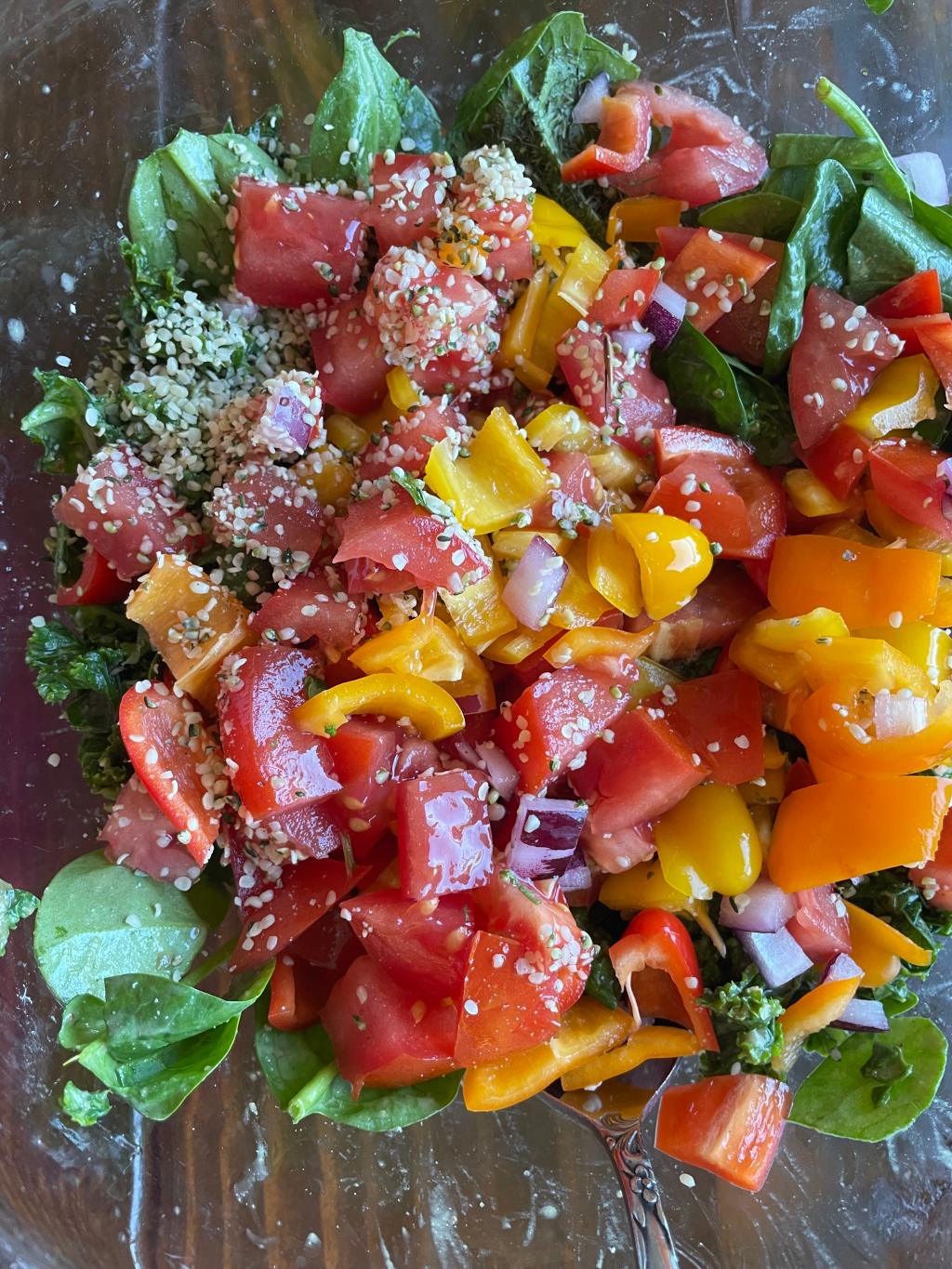
On top of all the greens, we’re adding colorful mini bell peppers and tomatoes, so our “green” salad doesn’t stay all green. That’s on purpose.
I don’t want you worrying about making a meal fit neatly into one color category. Nature doesn’t work that way, and neither should your dinner.
Why Massage Kale?
If you’ve ever tried eating a bowl of raw kale, you probably understand why massaged kale became a thing. Kale leaves are sturdy. That’s one of the reasons they hold up so well in salads, but it can also make them tough and a little intimidating when they’re raw. (Plus, they get stuck in your teeth).
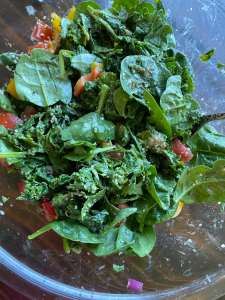
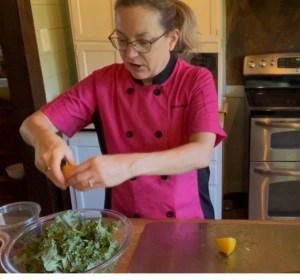
Massaging the leaves with lemon juice and a little salt breaks the cell walls and softens them. The kale decreases in volume, becomes easier to chew, and takes on the flavors you’re massaging into it.
You don’t need to massage it for 20 minutes. I use my hands and work the lemon juice into the leaves until the kale softens and starts to look darker and a little glossy.
Yes, I usually wear gloves.
I Lightened Up My Original Recipe
I’ve made versions of this salad for years, but when I pulled out my original recipe, I realized it contained avocado, tahini, almond butter, walnuts, and pumpkin seeds.
Those are all nutritious whole foods, but I don’t need all four of them in the same salad.
This is something I think we should talk about more often in whole-food, plant-based cooking. It’s easy to eliminate oil and then unintentionally pile several concentrated whole-food fat sources into the same meal. A little avocado goes into the dressing, then we add tahini, nuts, seeds, and maybe another nut-based sauce on top.
For this version, I’m using half an avocado and one tablespoon of almond butter, and a tablespoon of hemp seeds for a little crunch.
It’s still creamy but much lighter than my original version.
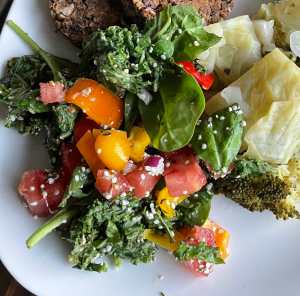
My Massaged Kale Salad
Serves 4
Ingredients
- 1 bunch kale, washed, destemmed, and torn into bite-sized pieces
- 1 lemon, juiced
- ¼ teaspoon sea salt, optional
- ¼ cup apple cider vinegar
- ½ avocado
- 1 Tablespoon almond butter
- 4 cups baby spinach
- 2 teaspoons Italian seasoning
- 4 mini bell peppers, diced
- 1 tomato, chopped
- 1 Tablespoon hemp seeds
Instructions
- Place the kale in a large salad bowl. Add the lemon juice and sea salt, if using. Massage the kale with your hands until the leaves soften, darken slightly, and decrease in volume.
- Add the avocado, almond butter, and apple cider vinegar. Continue massaging until the avocado and beans break down and everything forms a creamy coating on the kale.
- Add the spinach, Italian seasoning, bell peppers, and tomato. Toss everything together until the vegetables are evenly coated.
- Sprinkle the hemp seeds over the salad and serve.
Don’t Have Kale?
This is where you can start playing with your greens.
If you don’t have kale, try thinly sliced collard greens, shredded Brussels sprouts, or finely shredded cabbage or Napa cabbage. They’ll give you a different texture and slightly different nutritional profile while keeping a cruciferous vegetable in the salad.
You can rotate the spinach, too. Try arugula, romaine, bok choy, or another leafy green you haven’t eaten recently.
If you usually make this with kale and spinach, next time make it with kale and arugula. Another week, try shredded Brussels sprouts and Napa cabbage.
The recipe stays familiar, but the plants change.
That’s an easy way to create more variety without constantly searching for new recipes.
What About Oxalates?
I know some of you are going to ask about the spinach. It gets a bad rap.
Spinach is relatively high in oxalate compared with many other leafy vegetables. For most people, that doesn’t mean we need to avoid spinach. Individual circumstances are different; however, particularly for people who have been advised to limit dietary oxalate because of certain types of kidney stones or other medical considerations.
If you’re limiting oxalates or want to rotate your greens, leave out the spinach and use another green like bok choy, Napa cabbage, or arugula.
Variety makes this easy. You don’t need spinach to make a nutritious salad.
Look Beyond the Color
I want you to notice something the next time you’re standing in front of all those greens in the produce department. They’re not just different versions of the same food.
Kale, spinach, arugula, bok choy, parsley, broccoli, cabbage, collards, and sprouts are all green, but each has its own combination of nutrients, phytonutrients, fibers, flavors, and textures.
You don’t have to know all of the biochemical pathways before you put them in your cart. Start by choosing more variety.
Take them home and ask the question I keep coming back to, How can I make this taste really good?
Sometimes the answer is as simple as a really good salad.


Leave a Reply