
Creamy Mexican White Bean Dip & A Rainbow Dipping Plate
By Jennifer Whitmire, MS, MEd, CHES
Earlier this week, I told you I don’t just want you to eat the rainbow. I want you to understand it.
Today, we’re taking that idea into the kitchen.
The good news is that you don’t have to create an elaborate meal with every color on your plate. One of the easiest ways to add more color to your diet is to dip vegetables into something really good.
That’s what we’re doing today, except we’re going to pay a little more attention to what’s actually on the plate.
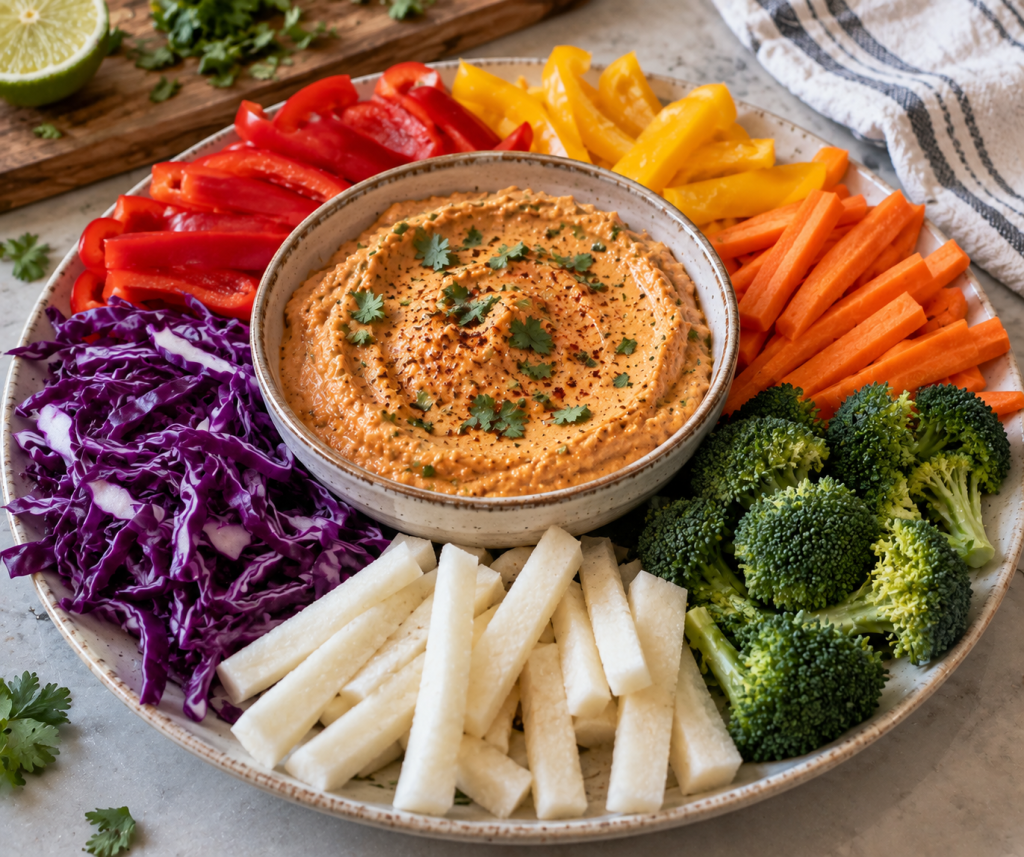
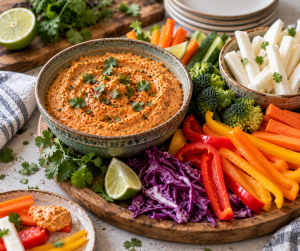
Our plate has mini bell peppers (red, orange, and yellow), orange carrots, purple cabbage, green broccoli, white jicama, and a creamy dip made from white beans and red pepper. There is a lot more going on here than just making a pretty plate.
Start Looking at Your Food Differently
This is what I want Understand the Rainbow to help you do.
Instead of looking at a carrot and thinking, “This is a vegetable,” I want you to start wondering why it’s orange.
Carrots are rich in carotenoids like beta-carotene. Your body can convert beta-carotene into vitamin A, which is important for vision, immune function, and the maintenance of healthy tissues like your intestinal lining. Carotenoids are also in foods such as pumpkin, sweet potatoes, peppers, tomatoes, and dark leafy greens.
Now look at the purple cabbage.
That beautiful color comes from anthocyanins, a family of plant pigments responsible for many of the red, purple, and blue colors we see in plant foods. You’ll find them in blueberries, blackberries, purple potatoes, red cabbage, and many other deeply dark-colored plants.
Broccoli is another example of how much chemistry can be hiding inside an ordinary vegetable.
Broccoli belongs to the cruciferous vegetable family. Crucifers contain compounds called glucosinolates that can be converted into other compounds, including isothiocyanates. This is one of the places where food preparation gets especially interesting because chopping, chewing, and cooking can influence some of that chemistry.
Once you begin learning what these foods contain, you start seeing that ordinary plate of vegetables in a new way. There’s an incredible amount of biochemistry sitting right in front of you.
I realize I’m probably more excited about this than most people, but stick with me. This is where understanding your food starts to get really interesting.
Wait. What About the White Foods?
This might actually be my favorite lesson on this plate.
When we talk about eating the rainbow, it would be easy to assume that more color means more nutrition, but that’s not how it works.
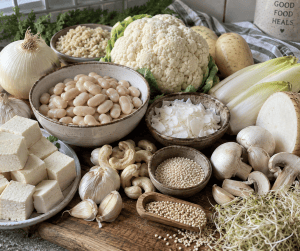
Our dip starts with cannellini beans, and we also have white jicama on the plate. Think about garlic, onions, cauliflower, and mushrooms, too.
None of them is going to win the brightest-food-on-the-plate contest, but they are still packed with nutrition and belong on our plate.
White beans give this dip fiber and protein with minerals such as iron, magnesium, and potassium. Jicama is a source of vitamin C and contains inulin-type fructans, fermentable fibers that can help feed beneficial gut bacteria. Garlic and onions contain organosulfur compounds as well as prebiotic fibers, and mushrooms have their own unique mix of nutrients and bioactive compounds, including beta-glucans and ergothioneine.
That’s a lot happening in foods that don’t look particularly colorful. This is why I don’t want Understand the Rainbow to become another set of food rules.
Color is a clue, but it isn’t the complete story.
There are thousands of compounds in plant foods, and we certainly can’t see all of them. Color gives us one interesting place to begin.
You Don’t Need Every Color at Every Meal
Please don’t finish reading this and think every plate has to have all of the colors. That’s not the point.
If breakfast is mostly green and purple (A green smoothie with blueberries), that’s perfectly fine. Lunch might have red, orange, and white, and dinner might have completely different plants.
I’m much more interested in what happens over the course of your day and your week.
Are you eating the same three vegetables over and over, or are you rotating greens, herbs, cruciferous vegetables, mushrooms, beans, sprouts, roots, berries, peppers, onions, and all the other incredible foods available to us?
I had a client who ate the exact same red, green, and orange vegetables every day for a year: tomato, cucumber, and carrot. Those are all healthy foods. There was nothing wrong with eating them, but imagine how much more variety she could add by sometimes choosing red bell pepper instead of tomato, kale instead of cucumber, or sweet potato instead of carrot. Now we’re exposing the body to a broader range of nutrients and phytonutrients without making healthy eating any more complicated.
Eating a variety of plant foods gives us exposure to a broader range of nutrients and phytonutrients. That’s one reason “eat the rainbow” can be such a useful shortcut.
The actual science is much more complicated than matching one color with one health benefit. That’s why I want us to go beyond memorizing a chart that says purple foods do this and orange foods do that.
I want you to understand the food.
Now Make It Taste Good
This is probably the most important part.
You can know everything there is to know about carotenoids, anthocyanins, and glucosinolates, but if that plate of vegetables sits untouched in your refrigerator until the broccoli turns yellow, none of that knowledge did you much good.
One of my favorite questions to ask is, “How can I make this taste really good?”
For this plate, the answer is a creamy Mexican-inspired dip made with cannellini beans.
I love using beans as the base for creamy dips and dressings, because they give you that creamy texture while also adding another whole, plant food to the meal.
Beans are high in fiber, protein, minerals, and resistant starch. Add red bell pepper, lime, nutritional yeast, cumin, and chili powder, and those vegetables have somewhere very good to go.
If raw vegetables aren’t your thing, that’s fine. Steam the broccoli, roast the peppers, or bake some jicama fries. Use the vegetables you’ll actually enjoy eating.
If it doesn’t taste good, you’ll probably never eat it again.
Creamy Mexican White Bean Dip
Ingredients
- 1 cup cannellini beans, drained and rinsed
- ½ red bell pepper
- 2 tablespoons nutritional yeast
- 1 tablespoon apple cider vinegar
- 1 tablespoon fresh lime juice
- ½ teaspoon ground cumin
- ½ teaspoon chili powder
- ¼ teaspoon garlic powder or 1 small garlic clove
- ¼ teaspoon sea salt, optional
- 2–4 tablespoons water, as needed
- Pinch of cayenne or chipotle powder, optional
Directions
Add all of the ingredients except the water to a high-speed blender.
Start with 2 tablespoons of water and blend until completely smooth and creamy. Add additional water, one tablespoon at a time, until the dip reaches the consistency you like.
Taste and adjust the lime, cumin, chili powder, or salt as desired.
Build Your Rainbow Dipping Plate
You don’t need to buy every vegetable on this list. Open your refrigerator and see what you already have.
- Red: red bell pepper, radishes, or cherry tomatoes
- Orange: carrots, orange bell pepper, or sweet potato cubes
- Yellow: yellow bell pepper or yellow squash
- Green: broccoli, cucumber, celery, or snap peas
- Purple: purple cabbage or purple asparagus
- White: jicama, cauliflower, or mushrooms
Arrange a few different colors around your dip, and you’re done.
You don’t need a complicated recipe or a perfectly constructed meal to add more variety to your diet. Sometimes it really can be as simple as a plate of colorful vegetables and a dip you enjoy.
This Is What I Mean by Understanding the Rainbow
I still want you to eat more colors. Now I also want you to start looking at those colors with a little more curiosity.
The next time you’re standing in the produce department or looking into your refrigerator, don’t worry about creating a perfect rainbow. Choose something you haven’t eaten in a few days. Try a different color, or pick up a vegetable you’ve forgotten about.
Ask my favorite question, “How can I make this taste really good?”
The more you understand about the food you’re eating, the easier it becomes to make intentional choices in the kitchen. My goal is to help you connect the science with the food on your plate, so you know not only what to eat, but why you’re eating it and how to make it delicious.
References & Further Reading
National Institutes of Health, Office of Dietary Supplements. Vitamin A and Carotenoids: Fact Sheet for Health Professionals.
Mattioli R, Francioso A, Mosca L, Silva P. Anthocyanins: A Comprehensive Review of Their Chemical Properties and Health Effects on Cardiovascular and Neurodegenerative Diseases. Molecules. 2020;25(17):3809.
Le TN, et al. The Multifaceted Health Benefits of Broccoli: A Review of Glucosinolates, Phenolics and Antimicrobial Peptides. International Journal of Molecular Sciences. 2025.
González-Vázquez M, Calderón-Domínguez G, Mora-Escobedo R, et al. Polysaccharides of Nutritional Interest in Jicama (Pachyrhizus erosus) During Root Development. Food Science & Nutrition. 2022;10:1146–1158.


Leave a Reply