
By Jennifer Whitmire, MS, MEd, CHES, NEP
We’ve talked about green broccoli, red tomatoes, and orange carrots. This week, we’re moving into blue and purple foods, starting with my favorite.
Blueberries.
Most of us have heard that blueberries are full of antioxidants, and they do. But, what does that mean? What are those compounds? What happens to them after we eat the blueberries? Do they actually get absorbed exactly as we ate them?
As you can probably guess, it’s more complicated than that.
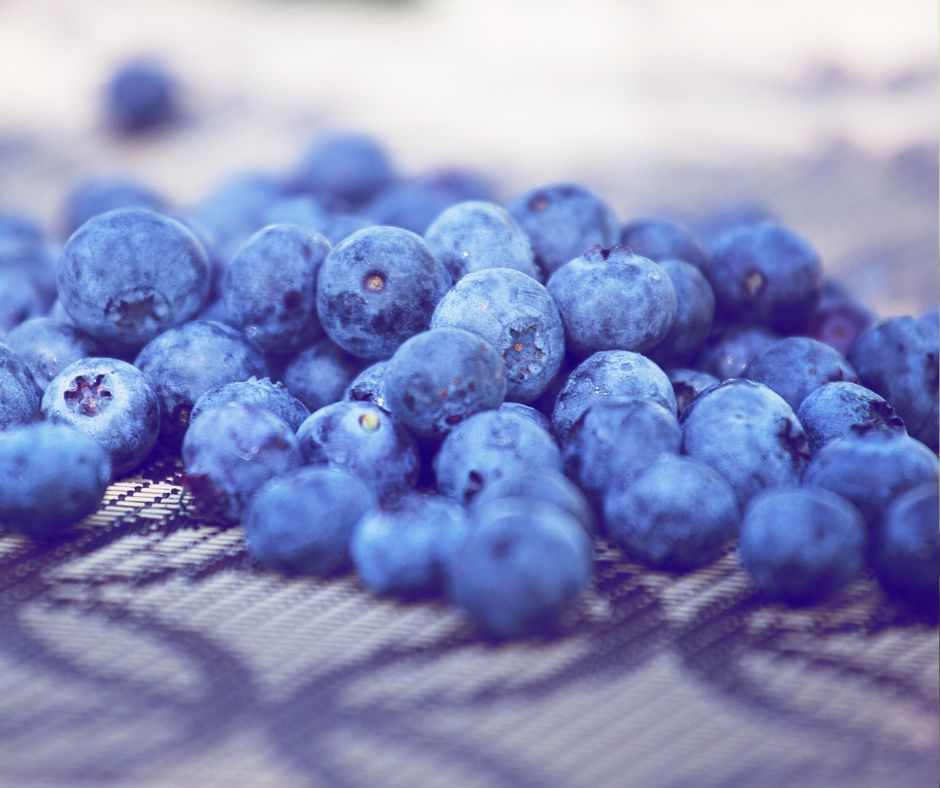
Why Is a Blueberry Blue?
Much of that beautiful, blue-purple color comes from anthocyanins.
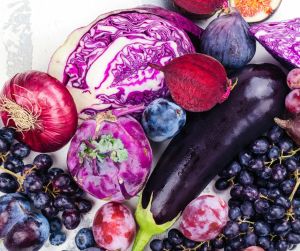
Anthocyanins are plant pigments that belong to a larger family of compounds called polyphenols. They’re also found in blackberries, cherries, red and purple grapes, purple cabbage, purple potatoes, purple carrots, and many other deeply dark-colored foods.
If you’ve ever wondered why some blueberries look almost purple while others are very dark blue, anthocyanins are a big part of what you’re seeing.
You’ll hear anthocyanins called antioxidants, which they are, but why do we care?
What Does “Antioxidant” Actually Mean?
Why do we hear the word antioxidant all the time?
Blueberries have antioxidants, and so do green tea and dark chocolate. I think we’ve turned “antioxidant” into another word for “healthy.”
An antioxidant is a substance that can help limit oxidation, a normal chemical process that can produce highly reactive molecules called free radicals. Our bodies make free radicals naturally, and we are also exposed to things that can increase their production. When free radicals build up faster than our antioxidant defenses can manage them, we call that oxidative stress. Too much oxidative stress can damage proteins, fats, DNA, and other parts of our cells.
Our bodies have their own antioxidant defense systems, and compounds in food can interact with those systems in different ways.
Anthocyanins can participate in antioxidant chemistry. Researchers are studying how anthocyanins and the compounds produced from them may interact with inflammatory signaling, blood vessels, cellular responses to oxidative stress, and the gut microbiome.
That last one is especially interesting, because the anthocyanin you eat isn’t necessarily the compound your body eventually encounters.
You Share Your Blueberries With Your Gut Microbes
When you eat blueberries, you chew them and begin breaking apart the food matrix. Digestion continues as they move through your digestive tract. Some of the anthocyanins are absorbed and metabolized along the way.
A small amount of anthocyanins circulates in the body as the original anthocyanin you ate. Some anthocyanins continue through the digestive tract with various breakdown products and eventually encounter the microbes living in your colon.
Those microbes can transform these compounds even further. They produce smaller phenolic compounds that can then be absorbed and metabolized by us.
I find that fascinating.
We talk about what a food “contains.” A cup of blueberries contains this much of this nutrient and that much of that phytonutrient.
Is that useful information? Absolutely.
Does that tell us everything? Not even close.
What we eat has to be released from the food and broken down, digested, absorbed, transformed, and metabolized. Sometimes our gut microbes get involved in that transformation, too.
This Is Another Reason I Keep Talking About Variety
As I am sure you know, blueberries aren’t the only way to get anthocyanins.
Blackberries, cherries, purple cabbage, purple carrots, purple potatoes, red and purple grapes, and even walnuts contain anthocyanin.
That doesn’t mean all of those foods are nutritionally interchangeable.
A blueberry has a combination of fibers, vitamins, minerals, and phytonutrients. Purple cabbage has another, and walnuts have a completely different nutritional profile.
This is why I don’t want you to find the one food with the most anthocyanins and decide that’s the one you should eat every day.
Rotate your foods.
If blueberries are on sale this week, wonderful, grab them. Next week, blackberries may be easy to find.
Shred some purple cabbage into your salad. Pick up purple carrots or purple green beans whenever you see them.
Try a purple sweet potato. Some are purple on the inside and some are purple on the outside but white on the inside, so eat the skin, too!.
You don’t have to know exactly how many milligrams of anthocyanins are in any of them.
Have You Ever Put Lemon Juice on Purple Cabbage?
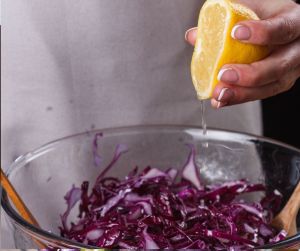
Here’s where we can actually see some of this chemistry in the kitchen. Anthocyanins are sensitive to pH.
If you’ve ever added lemon juice or vinegar to purple cabbage and noticed the color becoming brighter or more reddish-pink, you’ve watched chemistry happen right on your plate.
Change the pH in the other direction and the color can shift toward blue or even green.
Heat, oxygen, storage, and cooking can affect anthocyanins, too.
Does that mean we should only eat purple foods raw? No.
Don’t worry about preserving every last anthocyanin in your cabbage. Raw purple cabbage is great in a slaw, and cooked purple cabbage is delicious.
Fresh blueberries are wonderful, but if it is not summer, I keep frozen blueberries always on hand in the freezer.
Different prep and storage methods change food. That’s something we’ve been exploring throughout this entire series. It doesn’t automatically make the food better or worse.
Yes, Frozen Blueberries Count
Fresh berries can be expensive, and they have an annoying habit of becoming moldy about five minutes after you buy them. Grow your own or gather them when they are fresh in summer, or buy frozen.
I use frozen berries all the time, actually daily.
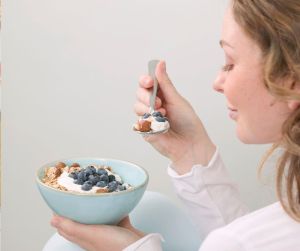
They’re easy to add to a smoothie or breakfast bowl, they’re available year-round, and you don’t have to worry about eating them before they go bad.
Eating well doesn’t require a refrigerator filled with picture-perfect produce.
Don’t Turn the Blueberry Into a Supplement
We’ve done this with so many foods.
A new study comes out about an interesting food component. It’s studied, isolated, and added to a new supplement bottle. Suddenly, everyone is buying the supplement instead of eating the food.
I want you to understand that anthocyanins are one of the interesting things inside blueberries, but blueberries come packaged with many chemicals that work together to keep us healthy. Those chemicals are not extracted into supplements.
The blueberry also contains fiber and many other nutrients and plant compounds. You’re eating all of those together, inside the structure of a whole food, and I don’t think we (humans) will ever understand the complexity.
That brings me back to the same question I keep asking as we work our way through the rainbow, What else is in there?
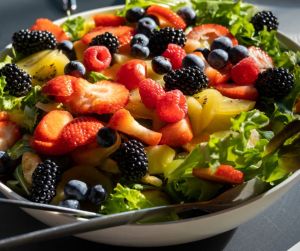
From Tomatoes to Carrots to Blueberries
There’s a reason I’m building these articles on one another.
The tomato helped us look at bioavailability. Chopping, blending, cooking, and what we eat with a food can influence how accessible some compounds are to our body.
The carrot added conversion. Beta-carotene isn’t the same as vitamin A. Our bodies have to convert it.
The blueberry adds the microbiome. Our gut microbes can participate in what happens to some of the compounds we eat.
There is a lot happening between the fork and our cells.
You don’t need to memorize all of it. I certainly don’t want you standing in the produce department trying to remember the metabolic fate of anthocyanins.
Pick up the blueberries, buy the purple cabbage, and try the weird, purple carrot. (When we first tried them, our kids had a really hard time trying purple potatoes. I get it! Sometimes, the food looks a little too weird)
Find a “new to you” purple food, take it home, and figure out the part that may be even more important for whether you’ll buy it again. How can I make this taste really good?
If it doesn’t taste good, you’ll probably never eat it again.
References & Further Reading
Festa J, Hussain A, Al-Hareth Z, Singh H, Da Boit M. Anthocyanins and vascular health: A matter of metabolites. Foods.2023;12(9):1796. doi:10.3390/foods12091796. PMID: 37174334; PMCID: PMC10178014. Read the research PubMed Central (PMC)
Verediano TA, Martino HSD, Paes MCD, Tako E. Effects of anthocyanin on intestinal health: A systematic review. Nutrients. 2021;13(4):1331. doi:10.3390/nu13041331. PMID: 33920564; PMCID: PMC8074038..Read the research PubMed Central (PMC)
Xue H, Zhao J, Wang Y, Shi Z, Xie K, Liao X, Tan J. Factors affecting the stability of anthocyanins and strategies for improving their stability: A review. Food Chemistry: X. 2024;24:101883. doi:10.1016/j.fochx.2024.101883. PMID: 39444439; PMCID: PMC11497485. Read the research


Leave a Reply