
By Jennifer Whitmire, MS, MH, MEd, CHES
Have you ever wondered how something as simple as chopping, blending, or cooking can change the way your body interacts with food?
Think about chickpeas. You can eat them sprouted whole, cooked whole, mash them with a fork for a chickpea salad, blend them into hummus, or turn them into a crispy, savory cracker or bread.
It’s the same chickpea, but each preparation creates something different. Each preparation changes the flavor, texture, and the physical structure.
In this week’s Food As Medicine article, Are You Absorbing All the Calories You Eat?, we explored research showing that the structure of food can influence how much energy our bodies absorb.
Whole almonds provide an excellent example. Some of their fat remains enclosed within plant cell walls that our digestive enzymes cannot completely break down. Grinding almonds into flour or almond butter breaks down more of those cell walls, making more of the fat accessible during digestion.
Of course, chickpeas are different from almonds. They contain much less fat and a lot more starch. We can’t assume that the findings from studies on almonds apply directly to chickpeas; however, it is worth exploring.
Food preparation changes flavor, but it also changes the physical structure of what we eat.
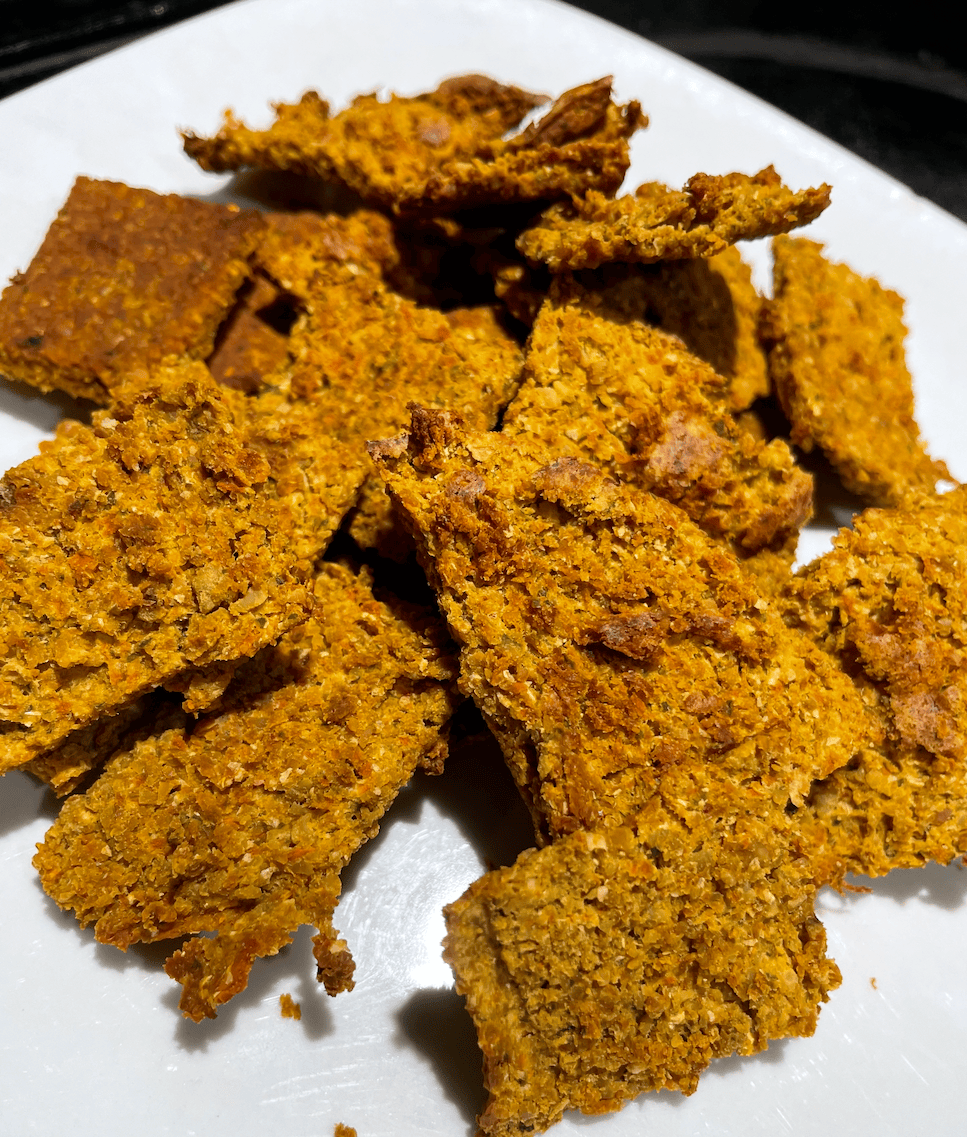
Today, we’re taking that idea into the kitchen and transforming cooked chickpeas and a few colorful vegetables into savory rosemary crackers.
What Happens When We Change the Structure of Food?
Plants are made up of cells surrounded by cell walls, and those walls help give vegetables, beans, nuts, and seeds their structure. When we chop, mash, grind, or blend plant foods, we break apart some of those structures.
Cooking introduces another set of changes.
Heat softens many plant tissues, alters proteins, and changes the structure of starches. In beans, cooking helps make starch more digestible and reduces certain naturally occurring compounds that interfere with digestion.
These changes can influence how digestive enzymes interact with food.
Think about the difference between a whole, cooked chickpea and a spoonful of smooth hummus. The chickpea has retained much of its original shape, and the hummus has been blended into a smooth mixture of much smaller particles.
Both can be part of a nutritious meal plan, but they aren’t identical.
Does that mean hummus provides more absorbable calories than whole chickpeas?
Not necessarily. We would need research comparing those particular foods to establish that, but we do know that food structure is an important part of nutrition.
Let’s Bring That Science Into the Kitchen
I love recipes that keep cooking simple and that demonstrate a principle.
For today’s recipe, we’re starting with fully cooked chickpeas.
We’ll blend them with zucchini, carrots, rosemary, and a few seasonings, then we’ll spread the mixture thinly and bake it slowly to remove moisture.
What we want is a thin, savory cracker that can be enjoyed with soup, vegetables, or your favorite, homemade spread. (Is it weird to have a chickpea cracker with hummus?)
Unlike most store-bought crackers, these contain no grain flour, oil, nuts, or seeds.
The ingredients and the preparation are simple and give us an opportunity to observe how blending and drying transform a familiar food.
Crispy Rosemary Chickpea Crackers
Whole-food plant-based | Gluten-free | Grain-free | Dairy-free | Oil-free | No nuts or seeds
Ingredients
- 1½ cups fully cooked chickpeas, drained and rinsed
- 1 small zucchini, grated
- 1 small carrot, grated
- 2 tablespoons nutritional yeast, optional
- 1 teaspoon dried rosemary, finely crushed
- ½ teaspoon garlic powder
- ½ teaspoon onion powder
- ¼ teaspoon smoked paprika
- 1 teaspoon sea salt, optional
Instructions
1. Prepare the vegetables.
Preheat the oven to 300°F and line a large baking sheet with parchment paper.
Grate the zucchini and carrot in the food processor
2. Blend the chickpeas.
Add the cooked, well-drained chickpeas in a food processor.
Process until they form a thick, fairly smooth paste.
3. Add the herbs.
Add the nutritional yeast (if using), rosemary, garlic powder, onion powder, smoked paprika, and optional salt.
Pulse until evenly combined.
The mixture should be thick and spreadable, not pourable.
4. Spread the mixture thinly.
Transfer the mixture to the parchment-lined baking sheet.
Place another sheet of parchment over the dough and use a rolling pin to spread it into an even layer, approximately 1/16 inch thick.
Remove the top parchment.
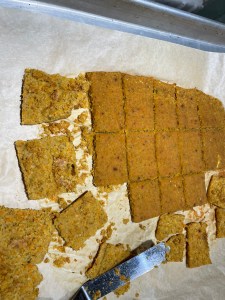
Use a pizza cutter or sharp knife to score the dough into approximately 24 crackers.
5. Bake slowly.
Bake for approximately 40-50 minutes, until the surface begins to firm.
Remove the baking sheet and carefully separate the crackers along the scored lines, if they’re firm enough to handle.
Flip the crackers and return them to the oven for another 20 minutes.
Check frequently during the final stages of baking, removing thinner pieces as they become dry.
The crackers should feel completely dry and not soft in the center.
6. Cool completely.
Transfer the crackers to a wire rack and allow them to cool completely.
If the centers remain soft, return them to a 250°F oven for another 10–15 minutes, then cool again.
Yield: Approximately 24 small crackers
Servings: 6 (4 crackers per serving)
Prep time: 15–20 minutes
Baking time: Approximately 55–75 minutes
Oven temperature: 300°F
A Little Color, A Lot of Nutrition
Even a simple cracker can bring several interesting plant foods together.
Orange: Carrots
Carrots contain carotenoids, including beta-carotene, which our bodies can convert into vitamin A as needed. Their orange color tells us something about the pigments they contain.
Grating the carrots breaks apart some of their structure, while cooking can improve the accessibility of certain carotenoids.
Green: Zucchini
Zucchini contains water, fiber, and a variety of micronutrients. Its mild flavor blends well with rosemary and garlic.
Because zucchini contains so much water, squeezing it before baking helps us achieve a drier texture.
Cream and Gold: Chickpeas
Chickpeas provide protein, fiber, starch, and minerals.
Their starch changes during cooking, becoming more accessible to digestive enzymes. Cooling cooked chickpeas can also promote the formation of some resistant starch, although the amount depends on preparation and storage.
For this recipe, we’re using fully cooked chickpeas and blending them into a smooth base.
Herbs and Spices: Rosemary, Garlic, and Paprika
Rosemary contains aromatic compounds that give these crackers their savory flavor.
Garlic and paprika add another layer of flavor without requiring added oil.
I love how a few herbs and spices can transform a simple ingredient like chickpeas into something completely different.
Paying Attention To Texture
One of the most interesting aspects of food preparation is how texture can changes.
Think about the difference you feel between biting into a whole chickpea, eating a smooth bean spread, or biting into one of these crackers. The structure of the food influences how we chew it, how quickly it breaks apart, and how digestive enzymes can access its components.
Texture may also influence eating rate and fullness, although those effects depend on the particular food, how it’s prepared, and how mindful you are while enjoying it.
When we turn chickpeas into crackers, we’re making several changes at once.
- First, we blend the chickpeas, reducing particle size and disrupting their structure.
- Second, we combine them with grated vegetables and seasonings.
- Third, we bake the mixture to remove moisture and create a firmer texture.
The result is a different culinary experience from eating chickpeas straight from the pot. That’s one of the reasons I find culinary nutrition so fascinating.
How to Enjoy Your Crackers
These savory crackers would pair nicely with a warm vegetable soup or a colorful plate of vegetables. You could also serve them with a homemade bean spread or your favorite oil-free dip. I’m thinking about serving mine with a Boursin-type cheese.
Try changing the herbs to create different flavors. Rosemary and garlic are wonderful together, but thyme, oregano, or Italian seasoning would also work.
Because these crackers contain cooked legumes and vegetables and haven’t been shelf-life tested, refrigerate them in an airtight container for up to 3–4 days or freeze for longer storage. They may need additional drying in a low oven to restore crispness.
It’s Not Just What’s in the Food
When we talk about nutrition, we usually focus on what a food contains.
How much protein? How much fiber? How many calories?
Those numbers give us useful information, but they don’t explain everything about how food behaves in our bodies.
A whole almond vs. almond butter.
Cooked chickpeas vs. hummus.
A raw carrot vs. a roasted carrot.
Each preparation changes something. That doesn’t mean one form is better than the other. We have more to consider than the numbers on a label.
For me, that’s part of the joy of cooking with whole foods.
We can choose different preparation methods for flavor, texture, convenience, and digestive comfort while learning a little more about the science along the way.
The next time you’re chopping vegetables, blending beans, or preparing something from scratch, think about what’s happening after you take that first bite.
You’re combining ingredients and transforming food, and understanding those transformations helps us become more confident, thoughtful cooks.
Read the ingredients. Eat the rainbow. Understand your food.
Curious about the research behind food structure and calorie absorption? Read this week’s Food As Medicine article, Are You Absorbing All the Calories You Eat?, to learn why the calories listed on a food label don’t always tell us exactly how much energy our bodies absorb.


Leave a Reply